Revenue Up.
Net Down?
Know Where the Money's Going.
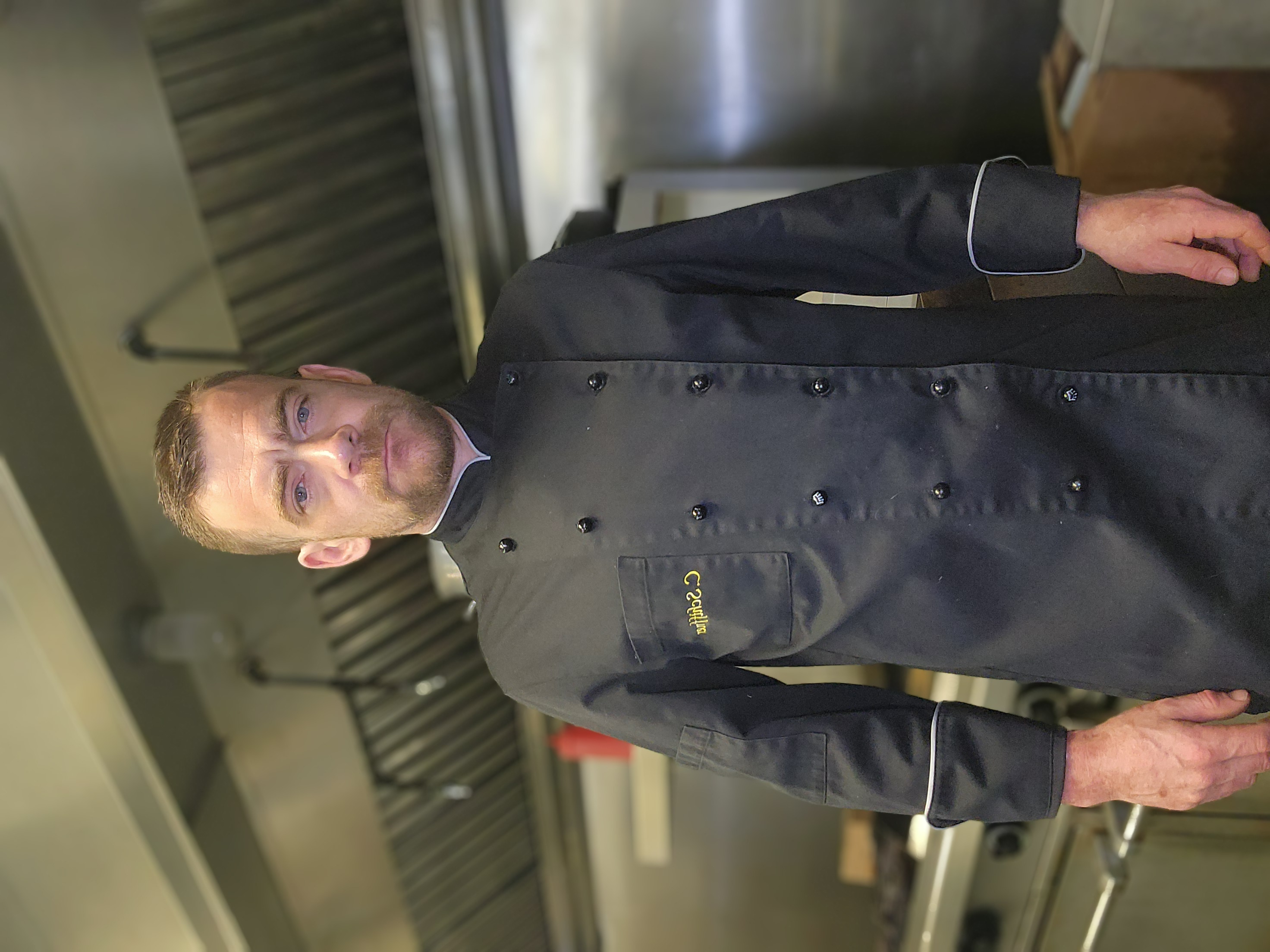
Built this kit from the rebuild. — Chris Schiffner, Küchenmeister
One weekend, and you stop guessing. You become the operator who knows exactly where the money's leaking — and walks into the next accountant meeting with an answer, not a shrug. The 3-day workbook shows you how, 90 minutes a day.
Your Restaurant Has Leaks.
You Just Can't See Where They Are.
You check the register at close. Sales look fine. You're not throwing money away on obvious things. But the bank account tells a different story every month.
Industry research identifies seven categories where independent restaurants consistently lose money. Most operators have five to seven of them running simultaneously. Not because they're bad at their job. Because no one ever showed them where to look.
Over-prepped proteins in the bin at close. Expired produce no one logged. The gap between what you planned to throw away and what you actually did.
Industry data: $15K–$40K/yearOwner doing $15/hour prep work. Scheduled hours not tied to actual covers. Paying a full crew for a half-house night.
Industry data: $10K–$30K/yearIndustry research puts the cost of replacing a single employee at $5,864 in lost productivity, recruitment, and training. Multiply by how many you replaced last year.
Industry data: $10K–$60K/yearGut-feel pricing without contribution margin data. High-cost items priced the same as low-cost ones. No engineering. Just guessing.
Industry data: $8K–$25K/yearSame supplier. No competitive quote process. No negotiation. For years. Loyalty is fine. Paying above market is not.
Industry data: $5K–$20K/year25 to 30 percent commission structures eroding every delivery order. Revenue goes up. Margin goes down. Nobody notices until the P&L.
Industry data: $5K–$15K/yearUntracked pours. Complimentary drinks with no system. Staff drinks that don't show up anywhere. Small amounts. Consistent pattern.
Industry data: $3K–$12K/year
Ranges are based on industry research data and represent estimates, not guaranteed results.
Individual restaurant figures vary based on revenue, category, and operational context.
Three Days.
One System. One Fix.
Most operators try to fix everything at once. That's why nothing gets fixed. The 72-hour process finds your single biggest leak and installs one system to address it. That's it.
Start Monday. By Wednesday you know exactly where you're losing the most money and you've started fixing it.
1
Not the map. The territory. You're going to physically walk your operation and measure what you actually throw away — not what you think you throw away. Most operators have never done this. The gap between the estimate and the real number is the leak.
2
You take the single biggest find from Day 1 and apply the 5 Whys. Not ten problems. One. You keep asking why until you hit the root system failure, not the symptom. Then you design one fix. Not a list. One.
3
You write a one-page protocol. You brief the team. You start measuring today. Not after the weekend. Not when things slow down. Today. The protocol builder keeps it to one page because anything longer won't survive a busy service.
Everything You Need.
Nothing You Don't.
Quick Start (10 min) + 3 daily 90-minute modules. The 72-Hour Profit Calculator. Portion Variance Tracker. Leak Ranking Matrix. Pre-Decided Response Card template. Dumpster Audit Checklist. No video course. No calls. You do it in your own kitchen on your own schedule.
Know the exact food cost percentage on every dish before you price it. No more gut-feel pricing on items you haven't actually costed.
Track your combined food and labor cost percentage week by week. Spot the trends before they become crises. The single number that tells you if your operation is healthy or not.
Map every menu item by profitability and popularity. Find the items that look busy but drain your margin. Find the ones that print money quietly.
Stop over-ordering. Stop under-ordering. Set par levels based on actual usage, not habit. Reduce food waste at the source.
Weigh what you throw away. Dollar-value every discard. The core tool for Day 1 of the 72-hour process. Most operators have never done this. The number is always surprising.
Run the real numbers on every delivery platform. After commission, packaging, and labor, how much are you actually keeping? For most operators, the answer changes how they feel about delivery.
A structured review of your menu layout, item placement, description copy, and price anchoring. Small changes here move money from low-margin to high-margin items without changing a single recipe.
Get competitive quotes. Track price movements across suppliers. Know when your supplier raises prices on a specific item without telling you. Most operators never look.
Step-by-step walkthrough of the Exposure, Diagnosis, and Install process. What to do each day. What tools to use. What questions to ask. Designed to work even if you're running a service that night.
After you've found the leak and installed the protocol, what do you actually do next? Days 4 through 7 walk you through the first week of running your new system — what to measure, what to look for, how to know if it's working.
Day 7 ends with a clear picture of what you've found and what comes next. You'll know your single biggest leak, have one system running, and understand which of the remaining categories to address. The guide tells you exactly how to read that picture.
Structured prompts for applying the 5 Whys to your biggest leak. Takes you from "we waste a lot of food" to the root system failure causing it.
The Day 1 audit document. Log every discard by category, item, quantity, and dollar value. Replaces vague estimates with empirical data.
Tracks the specific metric you're addressing week over week. You can't manage what you don't measure. This makes the leak visible and keeps it visible.
One-page format for your new operational protocol. The constraint is intentional — anything longer won't survive a busy service. Includes a team-brief script.
Pre-written Situation-Action responses for the most common exceptions your team will encounter. Takes the decision out of the moment and puts it in the card.
Honest About Who Gets Results Here.
The Sprint is not for everyone. Here's who gets value from it and who doesn't.
- You run an independent restaurant at $800K to $3M annual revenue
- You're busy. Probably profitable on paper. But you know something's off.
- You have direct control over purchasing, scheduling, menu pricing, and staffing
- You want to know exactly where you're losing money before you spend more trying to fix things
- You're done guessing and ready to look at actual numbers
- You can work through a structured process in your off-hours without hand-holding
- You're a chain or franchise operator without control over core decisions
- You're in active financial crisis needing capital — this is a diagnostic, not a rescue
- You want someone to fix it for you without doing any of the work yourself
- You're looking for a magic software tool that tracks everything automatically
- Your operation is under $500K — the leak ranges won't justify the process investment
I Built This in a
Yukon Kitchen After Losing Everything.
“I owed $370,000. The restaurant was open. The dining room was full. And I couldn't figure out where the money was going. I had no system for measuring anything. I was running on instinct after 15 years in professional kitchens and I was still losing.”

I started as an apprentice at Hotel Rothaus in the Black Forest in 2004, age 17. Over 20 years I cooked professionally in Germany, Switzerland, Austria, Spain, and Canada. I earned my Küchenmeister credential — the German Master Chef designation — which requires years of documented practice and examination under the German Chamber of Crafts.
None of that stopped me from losing $370,000.
What stopped the bleeding was measurement. A physical waste walk every day. Par levels set against real numbers, not habit. A vendor comparison process instead of loyalty. Menu engineering instead of gut-feel pricing. The frameworks in the Sprint are what I actually used in my own kitchen, working 80 to 140 hours a week, in a town of 1,300 people in the Yukon, with no margin for error and no consultant to call.
I rebuilt from $370,000 in debt in one of the most isolated restaurant markets in North America. The Sprint is the documented version of how I did it.
$197 vs. What You're
Already Losing Every Month.
A restaurant consultant charges $2,000 to $5,000 for an operational diagnostic. The Sprint packages the same structured process so you can run it on your own operation in a weekend. You don't need to clear your schedule or fly someone in.
Industry data suggests independent operators at $800K to $3M revenue may lose $2,500 to $5,500 per month to common profit leaks. The Sprint costs $197. That is less than two days of average monthly loss in a single leak category.
Per month. Across 7 leak categories.
Industry estimate for operators at your revenue level.
One-time. Instant download.
3-day workbook + calculator + trackers + Response Card.
If the 72-hour process finds one leak and you address it, the Sprint cost is recovered in days, not months. If it finds nothing — which would be unusual given what industry data says about operators at your revenue level — you spent $197 and got a profit calculator and trackers you can use in your kitchen from this week forward.
If you complete the 72 hours and don't surface a leak worth at least $10,000/year, email me and I'll refund you. No form. No call. Reply, get refunded.
The $197 price is for The 72-Hour Profit Sprint — the 3-day workbook, profit calculator, trackers, and Pre-Decided Response Card template. Industry data figures ($60K–$220K annual, $2,500–$5,500 monthly, $5,864 per employee) are estimates from industry research and do not represent guaranteed results. Individual restaurant outcomes vary.
Day 7 Is the
Beginning, Not the End.
By Day 7 you'll have found your single biggest leak and started fixing it. That's what the Sprint is built to do. But one leak is not your whole problem.
The Quick-Start Guide ends with a clear picture of what remains. Operators who want to address all seven leak categories systematically — not just the biggest one — can continue into the 21-Day Protocol.
Week 1: Interruption. Break the automatic decisions that caused the leaks.
Week 2: Criteria-Based Systems. Replace emotional decision-making with Situation-Action protocols.
Week 3: Pressure Testing. Validate every new system under real operational stress.
The guide tells you exactly when you're ready for it and what it covers. No hard sell. If you finish the Sprint and find one leak — you'll know whether you want to go further.
Questions Operators
Actually Ask.
Not ready for the Sprint?
Get just the tools for $47.
The 8 Excel calculators inside the Sprint, on their own, without the 3-day guided walkthrough. Recipe costing, prime cost, menu engineering, par levels, vendor comparison, delivery profitability, waste tracking, and menu psychology. Same tools. Self-directed. CAD 47, one time.
See the $47 Toolkit →Find Your Biggest Leak in 72 Hours.
Find My Biggest Leak — $197 CADWant me to walk you through this directly?
If you've bought the Sprint and want a second pair of eyes on what it surfaced — book a free 20-minute call. No pitch, no upsell script. You bring the numbers, I tell you where the bleed is and what to fix first. For serious operators only.
And if the Sprint surfaces a structural leak you can't close alone, that's what the 21-day Profit Recovery Engagement is for — the call is where it starts.
Book the 20-Minute CallFree • 20 minutes • No sales pitch
Where these numbers come from
Dollar-range estimates on this page are derived from National Restaurant Association operating cost benchmarks, U.S. Bureau of Labor Statistics restaurant labor data, and direct operator interviews and audits Christian conducted between 2005 and 2026 across Germany, Switzerland, Austria, Spain, and Canada.
Specific figures vary by restaurant size, location, menu mix, and labor structure. The ranges shown are typical, not guaranteed. Direct sources are available on request — email christian@thegrumpychef.ca.