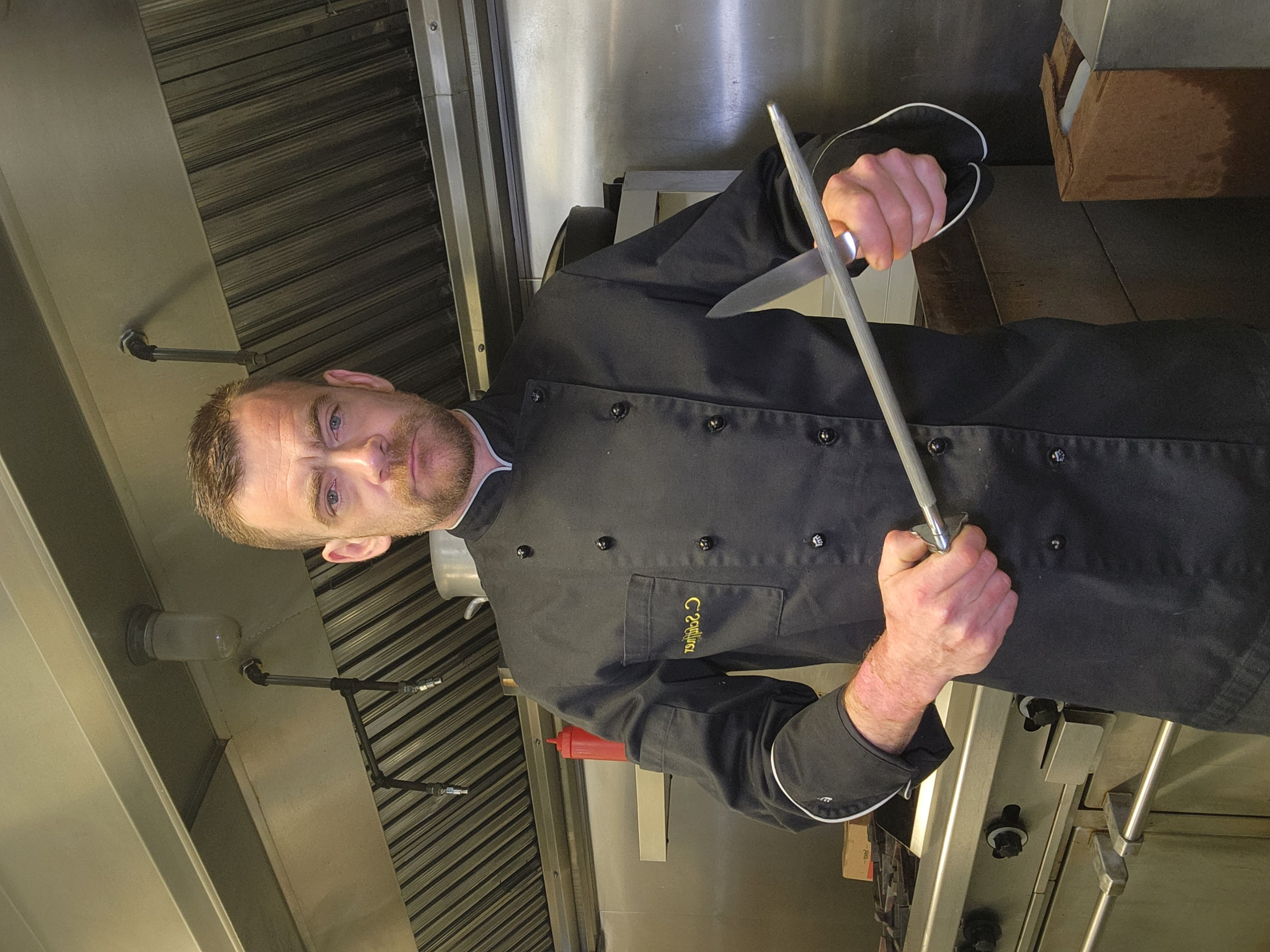
Restaurant portion control is how your food cost gets decided — not at the register, but at the prep table. A standard recipe with a locked portion spec means the margin is already inside every dish before service starts. Without it, margin is decided by whoever happens to be on the line that night.
Most operators treat portion control as a policing problem. Someone goes heavy on the protein, the manager checks the scale, there's a conversation. Repeat next week. That's not a system. That's supervision theater that breaks down the moment the kitchen gets busy.
The actual fix is upstream. Engineer the portion before the rush exists. When you do that, pressure has nothing to grab. The line isn't making margin decisions anymore — those decisions were already made at prep.
Food Cost Is Not Decided at the Register
Every operator I've talked to who has a food cost problem thinks it lives in their POS reports. They're watching percentages move and wondering what changed. The real answer is almost always the same: the portion spec isn't tight, so every cook who runs the line makes a slightly different call, and those decisions compound across hundreds of covers.
A two-ounce variance on a protein — easy to do when you're moving fast and there's no spec to reference — doesn't feel like much. Multiply it across your protein dishes, across a week of service, and you're looking at a meaningful food cost drift that shows up in your monthly numbers with no obvious cause.
The cause is always the same: the margin decision got delegated to the line, implicitly, by leaving the spec undefined.
"The plate was costed before it was cooked."
That's not a philosophy. That was the operating rule at Grumpy Schnitzel. Every item had a spec and a standard recipe. Same portion, same plate, every service. The margin was engineered into the dish at the recipe stage — not chased after the fact on a cost report.
What Over-Portioning Actually Costs You
Over-portioning is a silent leak. It doesn't announce itself. There's no broken equipment, no walkout, no supplier invoice that looks wrong. It just bleeds, quietly, on every plate that goes out heavier than the spec.
The math is straightforward. If your protein spec is 200 grams and your line is consistently plating 230 grams, you're running 15% over on that component. On a dish where protein is your biggest cost, that 15% variance can shift your food cost percentage by several points without anyone noticing until the month-end review.
Worse: over-portioning gets worse under pressure, not better. A quiet Tuesday service with an experienced cook might run tight. A slammed Friday with a newer cook who hasn't internalized the spec will run heavy. Your busiest nights — the ones that should be your most profitable — become your highest-cost nights. That's the wrong direction.
The spec removes that dynamic entirely. When the portion is defined at prep, the line isn't making a judgment call under pressure. They're executing a decision that was already made.
The Grumpy Schnitzel Standard: How It Worked in Practice
When I ran Grumpy Schnitzel, portion-spec discipline was one of the core levers that held food cost at a ~33.7% blended rate — with the July peak dropping to 28% — while sales nearly doubled. The kitchen got tighter as it got busier. That's not intuitive. Under normal conditions, a busier kitchen means more variance, more waste, more margin erosion.
It worked differently because the portions were already decided. Pressure had nothing to grab.
The Schnitzel Spec: A Real Example
The schnitzel went out as two pieces, 80–90g each, every single ticket. Not "about 160g of schnitzel" — two pieces, 80–90g each. The spätzle was portioned the same way off a standard batch. Every component had a defined output.
That specificity is the point. "About 160g" leaves room for interpretation under a rush. "Two pieces, 80–90g each" does not. The cook isn't estimating — they're counting and checking. Different cognitive load. Different result.
The standard recipe and the portion spec are inseparable. The recipe tells you what goes in the dish and how to cook it. The portion spec tells you exactly how much of each component leaves the kitchen on the plate. One without the other is incomplete.
Most kitchens have recipes. Far fewer have portion specs with the specificity that actually controls cost. "Season to taste" is fine for a recipe. "Two pieces, 80–90g each" is a portion spec.
Why the Rush Makes It Worse (Without a Spec)
Here's the dynamic that kills margins in kitchens that don't have portion specs locked in.
On a slow night, a cook can take a moment. They can weigh, adjust, think. On a slammed service, they're reacting. The ticket rail is full, the expeditor is calling, and the instinct is to plate fast. In that environment, portions drift heavy. It's not negligence — it's physics. Speed favors the generous hand.
A well-written portion spec, built into prep rather than service, eliminates this problem at the source. If the protein was portioned before service into 80–90g pieces, the cook on the line isn't making a weight decision at all. They're grabbing two pieces and plating. Fast is still fast. The spec is already inside the process.
This is the fundamental insight: portion control done right is invisible at service. It's not a check during the rush — it's a constraint engineered at prep so the rush can't touch it.
Building a Portion Spec That Actually Holds
A portion spec is only useful if it's specific enough that two different cooks reading it would plate the same dish. Vague language produces vague results.
What a Useful Spec Includes
- Proteins: Weight in grams, raw or cooked (specify which), and count if applicable. Not "6 oz chicken" — "175g chicken breast, cooked weight, one piece."
- Sides and starches: Volume or weight per portion from a standard batch. "80g spätzle from a 2kg batch" is actionable. "A scoop of spätzle" is not.
- Sauces and garnishes: Volume in millilitres, or a defined ladle size. High-cost garnishes get a count. "3 slices" beats "a few slices" every time.
- Visual reference: A plated photo of the correct portion, posted at the pass. Not as a replacement for the spec — as a supplement to it.
The spec should live in writing, posted in the kitchen near where the relevant prep happens. Not in a binder in the office. Not in a Google Doc nobody checks. On the wall, at eye level, where the work happens.
Build It Into Prep, Not Service
Proteins should be portioned before service wherever possible — into individual pieces at the specified weight during afternoon prep. Sides should be batched to a standard recipe that yields a predictable number of portions, so the cook knows they're serving exactly one unit of a pre-calculated portion, not estimating from a half-empty hotel pan.
This is prep table discipline. It's the difference between a kitchen that controls cost and a kitchen that hopes it did.
The Operator's Toolkit includes standard recipe costing templates that make this process faster to build for every dish on your menu. The math is already in the spreadsheet — you add the components, the weights, and the costs, and it tells you what the portion spec needs to produce to hit your target food cost.
Portion Specs and Food Cost: The Connection
A standard recipe without a portion spec is a recipe that costs differently every time it's executed. The spec is what converts a recipe from a cooking guide into a cost-control document.
When both exist — recipe and spec, together — you can cost the dish with precision. You know exactly what the ingredient inputs are, you know exactly what the plate output is, and the food cost that results is a known number, not an estimate. That known number is your margin, locked in before the first ticket of the night.
Food cost control is a prep table conversation, not a POS conversation. The POS shows you what happened. The prep table is where you decide what's going to happen.
If your food cost is drifting and you can't explain why — no supplier price changes, no menu changes — start at the spec. Check whether your portion specs exist, whether they're specific enough to be actionable, and whether they're being executed at prep. That's where the answer usually lives.
If you want the specs built and installed properly, the Profit Recovery Engagement is a 21-day working engagement that puts the standard recipes, portion specs, and cost-control framework in place for your specific operation. Not a course. Not a template pack. An installation.
The Prep Table Is the Margin Decision
The schnitzel went out as two pieces, 80–90g each, the same two pieces on every ticket. The spätzle was portioned the same way off a standard batch. Every component on every plate had a defined output.
That's not complexity. That's one decision, made once, that protects margin on every cover that follows.
Most kitchens leave that decision to whoever is working the line. That's not a cost problem. It's a missing-system problem. The cost is just the symptom.
Engineer the portion. Lock the spec. The margin is already inside the dish before the first ticket prints.
Frequently Asked Questions
What is restaurant portion control and why does it matter?
Restaurant portion control is the practice of specifying the exact weight, count, or volume of every component on every dish, and then prepping to that spec every service. It matters because food cost is decided at the prep table, not the register. Without a portion spec, you're handing the margin decision to whoever is on the line that night.
How do I implement portion control without slowing down service?
Build the spec into prep, not into service. Portion proteins before service, batch sides to standard yields, and pre-portion high-cost components. By the time a ticket prints, the portion decision is already made. The line isn't measuring anything — they're plating what was already portioned at prep. Done right, portion control is invisible at service.
Does portion control mean smaller plates?
No. Portion control means consistent plates. The spec can be generous — what matters is that it's the same every time. Inconsistency is the real problem: the plate that's 30 grams heavier on a busy Friday than a quiet Tuesday bleeds margin on your highest-volume nights, exactly when you need the numbers to work.