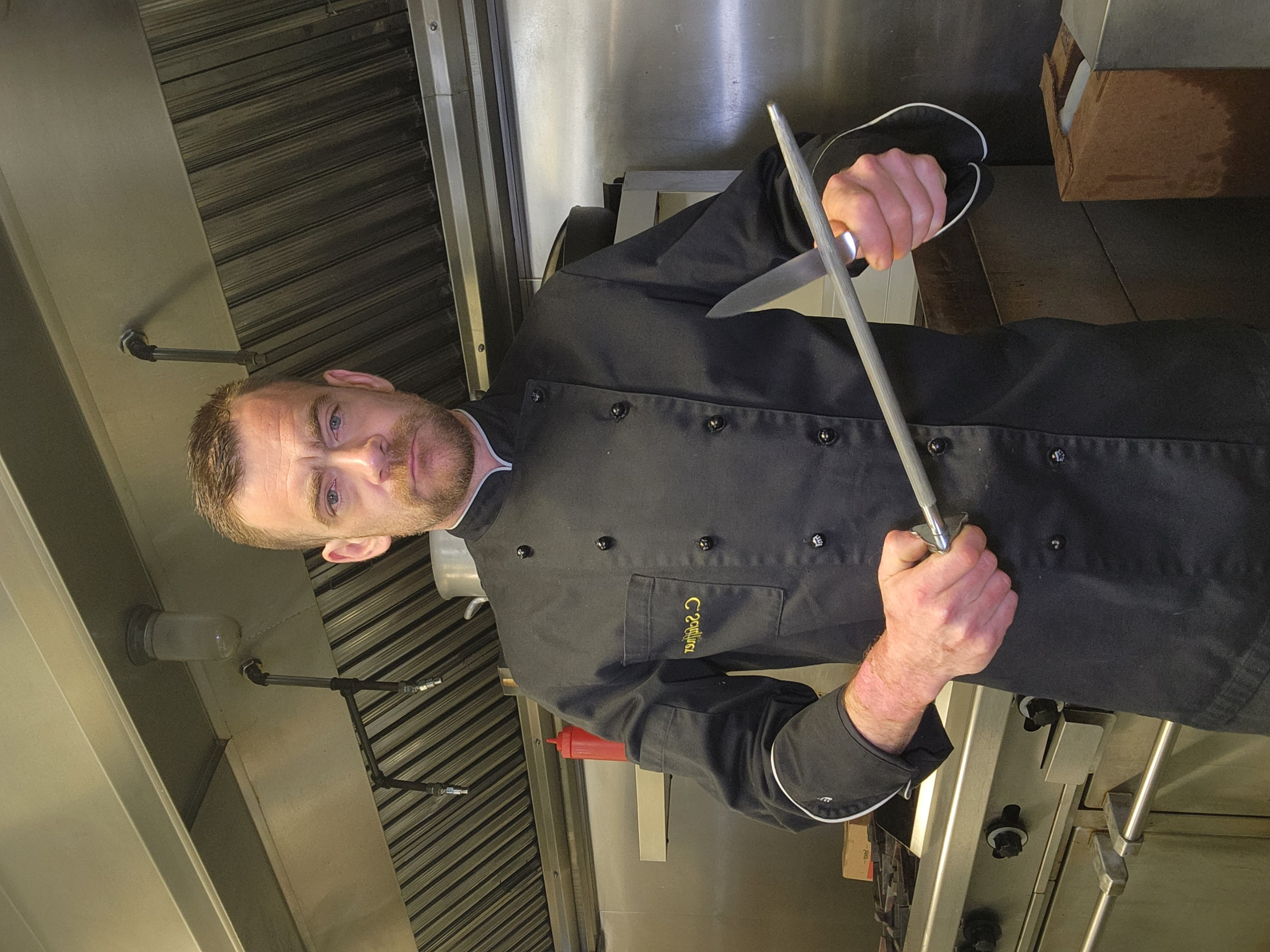
Your restaurant is busy but not profitable because revenue is not the problem — expenses are. Specifically, your prime cost (food + labor) is probably above 65% of revenue, you have menu items that sell well but lose money on every plate, and you have profit leaks in at least 3 of 9 categories you have never measured. Revenue masks the bleeding.
I know how this feels. You look at the dining room on a Friday night and every table is full. The kitchen is slammed. The bar is three deep. You are doing $8,000, $10,000, $12,000 nights. And then you check the bank account on Monday morning and wonder where it all went. The revenue was there. The profit was not.
This is the most dangerous position a restaurant can be in. Because busy feels like winning. Full tables feel like success. And as long as the doors are open and the dining room is packed, you tell yourself it will work out. It will not work out on its own. Busy does not mean profitable. They are completely different problems.
The Prime Cost Problem
Prime cost is your total food cost plus your total labor cost. That includes wages, benefits, payroll taxes, workers comp, and any contract labor. It is the single most important number in your restaurant and I would bet you do not know what yours is right now.
Here is the benchmark. Prime cost should be 55-65% of total revenue. Full-service restaurants typically land at 60-63%. Fast casual at 55-60%. If you are above 65%, you are almost certainly not profitable. And if you are above 70%, you are losing money every day you are open — no matter how many covers you do.
Let me show you the math on a $1,000,000 restaurant:
- Prime cost at 60%: $600,000 in food + labor. Leaves $400,000 for rent, utilities, insurance, supplies, repairs, debt service, and profit. Tight but workable.
- Prime cost at 68%: $680,000 in food + labor. Leaves $320,000 for everything else. That is $80,000 less. After fixed costs, your profit just went from slim to zero.
- Prime cost at 72%: $720,000 in food + labor. You are losing money. Period. No amount of revenue growth fixes this until the ratio changes.
An 8-point swing in prime cost on a million-dollar restaurant is $80,000 a year. That is the difference between a healthy business and a slow death. And most operators have no idea where they sit because they do not track prime cost weekly.
The Prime Cost Formula
Prime Cost = Total Food Cost + Total Labor Cost (including taxes and benefits). Divide by total revenue to get the percentage. Track it weekly. If it is above 65%, something is broken. If it is above 70%, you are losing money on every dollar of revenue. The fix is not more revenue — it is controlling the ratio.
The High-Volume Low-Margin Trap
This is the silent killer. You have menu items that sell incredibly well. Guests love them. Your servers push them. They are on every table. And they are destroying your margin.
In menu engineering, we call these Plowhorses — high popularity, low profitability. They work hard (high volume) but they do not pay well (low contribution margin).
Here is a real example. Your $15 fish tacos have a food cost of $6.25. That is a 42% food cost — already too high. But the real problem is the contribution margin: only $8.75 per plate. Meanwhile, your $26 braised short ribs have a food cost of $8.50 — a 33% food cost with a contribution margin of $17.50 per plate.
Every time a guest orders the fish tacos instead of the short ribs, you lose $8.75 in margin. If 40% of your guests are ordering Plowhorses because those items have the best menu placement and the longest descriptions, you are systematically directing traffic to your least profitable dishes.
Multiply this across a busy restaurant doing 200 covers a night. If even 30 of those covers shift from Plowhorses to Stars or fixed Plowhorses, at $8 extra margin per plate, that is $240 a night. $87,600 a year. Same number of guests. Same kitchen. Same staff. Different menu strategy.
The 9 Categories Where Money Disappears
After 20 years of cooking in kitchens across 5 countries and auditing restaurants that looked healthy on the surface, I have identified 9 categories where money leaks out of a restaurant. Most busy-but-not-profitable restaurants are bleeding in at least 3 of these simultaneously.
- Food Waste: Product that goes in the trash instead of on a plate. Trim, spoilage, over-prepped mise en place, returns. Typical leak: 4-10% of food purchases. Dollar range: $10,000-$25,000 per year on an $800K restaurant.
- Over-Portioning: Cooks putting more on the plate than the recipe specifies. A 10-15% over-portion on proteins alone can cost $5,000-$12,000 per year.
- Supplier Price Drift: Invoiced prices creeping above contracted prices without anyone noticing. Typical leak: $3,000-$10,000 per year.
- Menu Mix: Too many low-margin items selling at high volume. This is the Plowhorse problem. Potential margin loss: $20,000-$80,000 per year depending on menu size and volume.
- Labor Scheduling Gaps: Overstaffing during slow periods, understaffing during rush (which causes overtime). Typical waste: 3-8% of labor cost, or $5,000-$15,000 per year.
- Overtime and Shift Overlap: Scheduled overtime because "that is just how it is." Unplanned overlap between shifts. 30 minutes of unnecessary overlap per shift across 5 employees is 2.5 hours a day. At $18/hour, that is $16,425 per year.
- Comps and Discounts: Manager comps without tracking. Staff meals without limits. Discounts that are not measured against revenue impact. Typical untracked comp rate: 1-3% of revenue.
- Theft and Shrinkage: Product walking out the back door. Drinks poured without ringing. The industry average is 4-5% of total inventory, but most operators assume it is not happening to them. It is.
- Operational Inefficiency: Equipment that wastes product (the fryer that burns 1 in 10 batches). Prep methods that generate excessive trim. Cooking methods that cause high shrinkage. These are invisible costs buried in your process.
You do not need to fix all 9 at once. But you need to measure all 9 to find your top 3. Those top 3 will account for the majority of your leak. Fix those first. The full breakdown of each category — with dollar ranges — is in this guide to hidden profit leaks.
Two Restaurants, Both Busy, Both Losing Money
I need to tell you about the worst period of my career. Because it is exactly what you are going through right now.
I was running two restaurants. Both were busy. Both looked successful from the outside. Full dining rooms. Good reviews. Repeat customers. The kind of operation that makes other restaurant people say "those guys are killing it."
We were killing ourselves.
I was not tracking prime cost weekly. I was looking at monthly P&L statements — which means I was seeing problems 30 days after they started. By the time the numbers showed trouble, the damage was already done. Food cost had crept from 31% to 37% over six months. Labor was running at 34% because I was afraid to cut shifts when we looked busy. Prime cost: 71%. On paper, we were doing great revenue. In reality, we were losing money on every dollar.
That was part of the road to $370,000 in debt. Two busy restaurants. Both underwater. Because I confused busy with profitable.
The turnaround started when I stopped looking at revenue and started looking at prime cost. When I stopped celebrating full dining rooms and started measuring contribution margin per guest. When I stopped guessing and started tracking. That is the shift. From feelings to numbers. From busy to profitable.
I eventually lost one of those restaurants. The debt nearly destroyed me. I hit rock bottom. Got sober. Moved to Dawson City, Yukon — population 1,300 — and rebuilt from scratch using systems instead of hustle. Every framework I teach now comes from what I learned the hard way. All $370,000 worth of education.
How Prime Cost Tracking and the 9-Category Audit Fix This
The fix is not more marketing. It is not more seats. It is not longer hours. The fix is measurement.
Step one: calculate your prime cost this week. Pull your food invoices. Pull your labor reports including taxes and benefits. Add them together. Divide by revenue. That is your prime cost percentage. If it is above 65%, you now know why the bank account does not match the busy dining room.
Step two: run the 9-category audit. Spend 72 hours measuring each of the 9 leak categories. You do not need fancy software. Clipboards, scales, and your POS reports will do. Rank the leaks by dollar impact. Fix the top 3.
Step three: track weekly. Prime cost is not a monthly number. By the time your monthly P&L arrives, you have already lost 30 days of margin. Track prime cost every week. Set a target. Hold yourself to it.
The 72-Hour Profit Discovery Calculator walks you through this entire process. Plug in your numbers across all 9 categories and it tells you exactly where your biggest leaks are and what they cost you annually. Five minutes. No spreadsheet needed. Just honest numbers.
Your restaurant is not broken. Your tracking is. Fix the tracking, and the profit follows.
Frequently Asked Questions
What is prime cost in a restaurant?
Prime cost is your total food cost plus your total labor cost, including wages, benefits, payroll taxes, and any contract labor. It is the single most important number in restaurant operations because it typically represents 55-65% of total revenue. If your prime cost is above 65%, you are almost certainly not profitable — no matter how busy you are. A healthy full-service restaurant targets 60-63%. Track it weekly, not monthly. Monthly is too late to catch problems.
What profit margin should a restaurant have?
A healthy full-service restaurant should have a net profit margin of 5-10% after all expenses including rent, utilities, insurance, and debt service. Fast casual and quick service can hit 10-15% because labor costs are lower. Fine dining typically runs 3-7% because both food and labor costs are higher. If you are below 5%, you are one bad month away from trouble. If you are at 0% or negative, the fix is almost always in prime cost — food and labor — not in getting more guests through the door.
How do I find hidden profit leaks in my restaurant?
Start with the 9 categories where money disappears: food waste, over-portioning, supplier price drift, menu mix, labor scheduling gaps, overtime and shift overlap, comps and discounts, theft and shrinkage, and operational inefficiency. Track each category for 72 hours with simple measurement tools — waste logs, portion scales, invoice audits, POS reports. Most restaurants find that 3-4 of these 9 categories are responsible for 70% of their profit leaks. The 72-Hour Profit Discovery Calculator walks you through this process step by step.