Rebuild a failing restaurant in 21 days using the Recovery Protocol: Week 1 (Interruption) breaks your automatic panic reactions and installs a pause between stimulus and response. Week 2 (Criteria-Based Systems) replaces emotional decisions with pre-decided protocols for every recurring situation. Week 3 (Pressure Testing) stress-tests those systems to make sure they hold at 60% capacity. This is the exact framework I used after losing $370,000.
I'm not going to pretend this is easy. It's not. Twenty-one days of rewiring how you think, react, and operate your restaurant. It's uncomfortable by design. But comfortable got you here — panicking at 2am about payroll, throwing money at problems that keep coming back, working 80-hour weeks and still wondering where the profit went.
This protocol doesn't ask you to work harder. You're already working hard. It asks you to work differently. Systematically. With rules that hold even when you're exhausted, angry, or scared. Especially then.
Why 21 Days (Not Motivation Science)
Forget the "it takes 21 days to form a habit" myth. That's pop psychology. The real research says habits take anywhere from 18 to 254 days depending on complexity.
The 21-day timeframe isn't about habit formation. It's about nervous system intensity.
Twenty-one days is short enough that your brain can't negotiate. You can talk yourself out of a 90-day program by week three. "I'll start fresh next month." "Things are getting better, I don't need this anymore." "It's too hard right now, I'll pick it back up when things slow down."
But 21 days? You can do anything for 21 days. Your brain knows this. It can't negotiate with a timeline that short. There's no room for "let's see how it goes." You committed to 21 days. You do 21 days. Period.
The structure also matters. Three weeks. Three phases. Each phase builds on the last. You can't skip ahead. You can't cherry-pick. The protocol works as a sequence because each week prepares your nervous system for the next level of change.
Week 1: Interruption — Break the Autopilot
You're on autopilot right now. You don't know it because autopilot feels like "just how things are." But every panicked decision, every emotional reaction, every "we've always done it this way" — that's autopilot. And autopilot is what's killing your restaurant.
Week 1 has one job: break the automatic reactions.
The Pause
Every time you feel the urge to react — stop. Don't act. Don't fix. Don't yell. Don't call the supplier. Don't rewrite the schedule. Just stop.
Staff calls in sick 30 minutes before service? Stop. Feel the panic. Breathe. Then respond. Not react — respond. There's a difference. Reacting is automatic. Responding is chosen.
You're not fixing anything this week. You're just noticing. How many times per day do you react on autopilot? Most operators count 30-50 automatic reactions per shift. Thirty to fifty moments where you're not making decisions — you're running old programming.
Adding Friction
Modern restaurant life removes all friction. Phone always in your pocket. Credit card always available. Staff can text you at midnight. Suppliers can call during service. You're accessible to everyone, all the time. And it's destroying your capacity to think.
Week 1, you add friction back:
- Phone goes in the office during service. Not on silent in your pocket. In the office. Staff knows: emergencies only. Everything else waits.
- No menu changes without 24 hours of reflection. That flash of inspiration at 11pm? Write it down. Look at it tomorrow. Most "brilliant ideas" at 11pm are panic dressed up as creativity.
- No purchasing decisions over $200 without sleeping on it. The emergency order that "can't wait" almost always can wait 12 hours.
- Set communication hours for staff. Not 24/7 availability. Defined windows. Two hours in the morning. One hour before service. Emergencies only outside those windows — and define what "emergency" means in writing.
Environment Stabilization
Your first 60 minutes each day set the tone. Right now, your first 60 minutes are probably chaos — checking messages, putting out fires, reacting to whatever happened overnight.
Week 1 rule: First 60 minutes are yours. No phone. No email. No staff contact. Walk, sit in silence, review your plan for the day. This isn't meditation. It's operational preparation. A pilot doesn't take off while reading texts. Neither should you.
Week 1 Success Metrics
You're winning Week 1 if: you caught yourself on autopilot 10+ times daily, you paused before reacting at least 5 times per shift, you protected your morning routine 5 out of 7 days, and you felt uncomfortable. Discomfort means it's working. If Week 1 feels easy, you're not doing it right.
Week 2: Criteria-Based Systems — Situation = Action
Week 1 made your automatic reactions visible. Week 2 replaces them with pre-decided responses.
The idea is simple: for every recurring situation in your restaurant, decide in advance what you'll do. Write it down. Follow it every time. No exceptions. No "this time is different." No emotional improvisation.
Here are eight situations every restaurant faces. For each one, you create a criteria-based response:
- Staff calls in sick. Rule: Check the coverage list (which you created on day 8). Call person #1. No answer in 15 minutes, call person #2. No coverage available? Reduce the menu to the 10 highest-margin items and run short. No panic. No guilt. No working a double yourself unless the criteria specifically call for it.
- Food cost exceeds 33% on any single day. Rule: Pull the waste log. Identify the source. Adjust prep pars for the next service. If it's a pricing problem, flag the item for menu review on Sunday.
- A customer complains. Rule: Listen fully. Apologize once (sincerely). Offer a specific remedy (comp the item, offer dessert, or 20% off next visit — pick one, pre-decided). Don't argue. Don't explain. Fix and move on.
- Revenue is 20%+ below forecast for the day. Rule: Cut one staff member by the pre-decided time (usually 2 hours into service). Reduce prep for tomorrow by 20%. Review forecast assumptions on Sunday.
- A supplier shorts your order. Rule: Use backup supplier from your pre-built list (which you created on day 9). If no backup, adjust menu for the day. Do not panic-buy at premium prices unless the item affects more than 30% of your menu.
- You feel the urge to work past your shutdown time. Rule: Write down what you think needs doing. Look at it in the morning. Leave on time. "Just one more thing" is a lie — it's always three more things.
- Cash variance exceeds $25. Rule: Review the POS void log. Check comp records. If variance persists 3+ days, have a direct conversation with the closing staff. No accusations — just data.
- You want to change the menu mid-week. Rule: Write it down. Review on Sunday during your weekly planning session. If it still makes sense with clear data behind it, implement the following Monday. Not mid-week. Not on impulse.
These aren't suggestions. They're rules. You follow them every time, the same way, regardless of how you feel. Feelings are terrible decision-makers. Criteria are reliable ones.
The power of criteria-based systems is that they eliminate decision fatigue. You're making 300+ decisions a day as a restaurant operator. Every decision you pre-decide is one fewer drain on your mental energy. By the end of Week 2, you've pre-decided responses to the 8 most common situations. That's 8-15 fewer daily decisions that used to drain you.
Week 3: Pressure Testing — Does It Hold at 60%?
Week 3 is where you find out if your new systems actually work. Not on your best day. On your worst day. At 60% capacity. When you're tired. When you're short-staffed. When the delivery is late and the walk-in is half empty.
This is the 60% Capacity Rule in action. Any system that only works when everything goes right is not a system. It's a wish.
Deliberate Constraints
Week 3, you intentionally stress your systems:
- Run one shift with one fewer staff member than scheduled. Can your criteria-based responses handle it? Does the reduced menu protocol work? If not, revise it.
- Reduce your prep by 15% for one day. What happens? Do you run out of the right things or the wrong things? This shows you which items are over-prepped and which are critical.
- Enforce your shutdown time for 7 consecutive days. No exceptions. Not once. If the restaurant can't function without you staying late every night, the system is broken — not your commitment.
- Say "no" to at least one thing per day that you would normally say yes to. A staff request. A supplier upsell. A customer accommodation that costs you money. "No" is a complete sentence. Practice it.
Closing the "Just Once" Loop
The biggest threat to your new systems isn't that they don't work. It's that you'll make an exception. "Just this once, I'll stay late." "Just this once, I'll skip the waste log." "Just this once, I'll make the menu change without waiting until Sunday."
"Just once" is how every system dies. One exception reopens negotiation. Your brain remembers that you broke the rule and survived. So next time, it's easier to break it again. Then again. By week four, the rule doesn't exist anymore.
No exceptions. No "just once." The rule holds or it's not a rule. This is the hardest part of the protocol. It's also the part that makes it work.
What Happens on Day 22
Day 22 isn't a finish line. It's a starting line.
After 21 days, you have three things you didn't have before:
- Awareness — you can see your automatic reactions instead of being controlled by them
- Systems — you have pre-decided responses for the 8 most common situations
- Evidence — you know which systems held under pressure and which need revision
Day 22, you start the protocol again. Same three phases. Deeper application. The first cycle installed the framework. The second cycle refines it. Week 1 of cycle two catches the subtler autopilot reactions you missed the first time. Week 2 adds criteria for situations that didn't come up in the first 21 days. Week 3 pressure-tests at a higher level — maybe running two shifts short-staffed instead of one.
By day 63 — three full cycles — the systems are automatic. You don't think about them anymore. They're just how you operate. Your staff notices. Your numbers notice. Your bank account notices.
Most operators see measurable improvement by the end of the first cycle: $1,500-$4,000/month in recovered profit from waste reduction, labor adjustments, and eliminated panic spending. By the end of cycle three, that number typically doubles. Before you start the protocol, run the 72-hour profit discovery to identify which leaks to prioritize in Week 2.
The 21 Days That Changed Everything
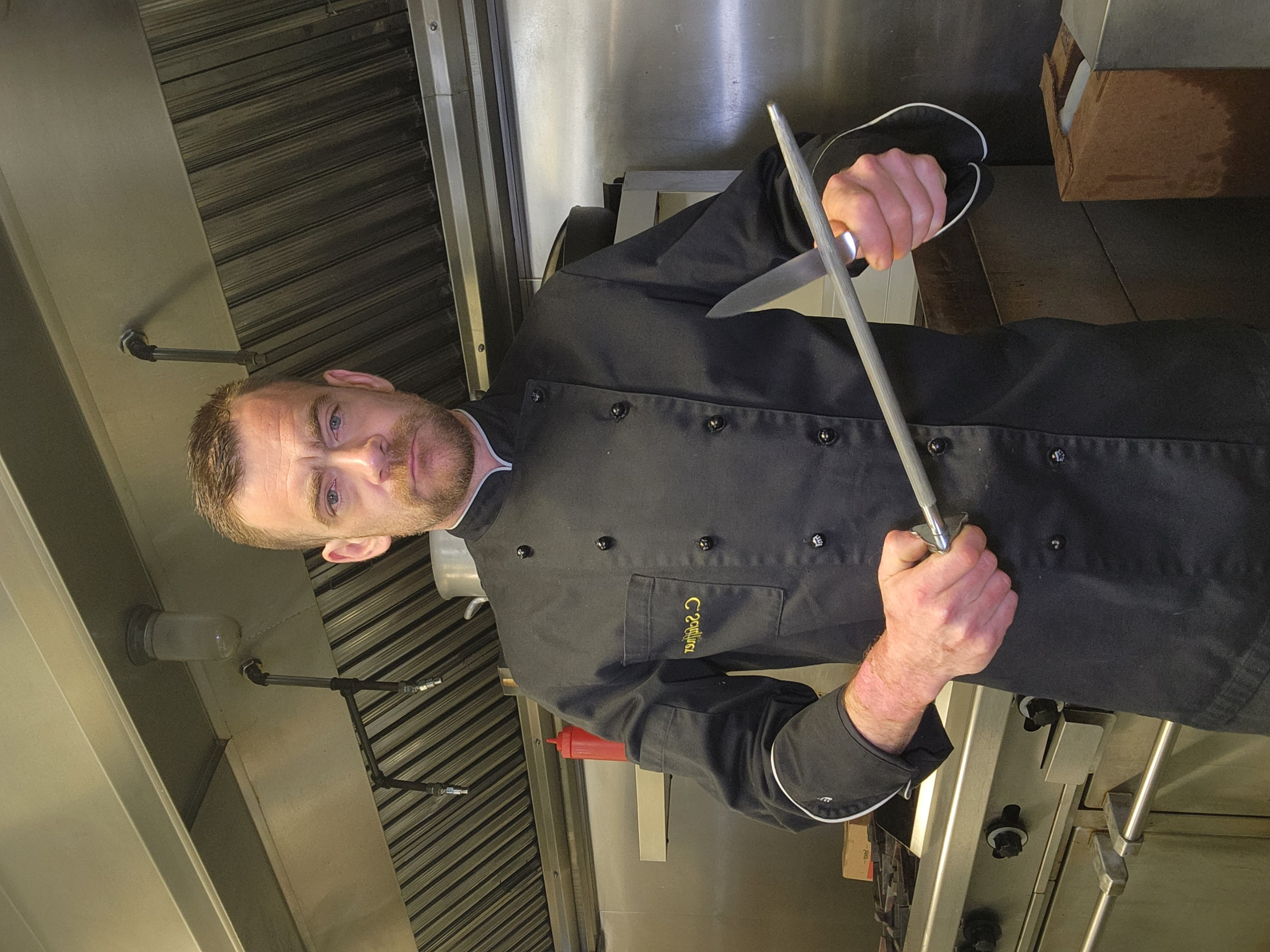
April 2022. I was $370,000 in debt. My restaurant was bleeding money. I was working 100-hour weeks and drinking to cope. Twenty years of professional kitchen experience — Germany, Switzerland, Austria, Spain, Canada. My Kuchenmeister certification. None of it mattered. I was drowning.
Everyone said work harder. I was already working harder than anyone I knew. That wasn't the problem. I was the problem. No systems. Just chaos and hustle and hoping tomorrow would be different.
I got sober. And recovery taught me something the restaurant industry never did: you can't motivation your way through a crisis. You need systems that hold when you're broken.
The principles that kept me sober — behavior leads belief, no exceptions, pre-decide everything, build for exhaustion — I applied them to my restaurant. Not as a business strategy. As survival.
Week 1, I stopped reacting. I noticed I was making 40+ panic decisions per day. Staff calls in sick — panic. Food delivery late — panic. Slow Tuesday — panic. I was in permanent fight-or-flight mode, and every "solution" I came up with from that state made things worse.
Week 2, I pre-decided everything. Staff sick? Here's the protocol. Food cost high? Here's the protocol. Customer complaint? Here's the protocol. I wrote eight rules on a piece of paper and taped it to my office wall. No more improvising.
Week 3, I tested it all at 60% capacity. My worst day — a rainy Tuesday in Dawson City with 14 covers. Did the systems hold? Could I leave on time? Could I not check my phone after closing? Yes. Barely. But yes.
That was over 1,200 days ago. Same restaurant. Same town of 1,300 people in the Yukon. Different operating system. The restaurant went from losing money to profitable. My work week went from 100 hours to 60. I haven't had a drink since.
The 21-Day Protocol didn't save my restaurant. It saved me. The restaurant just followed.
How the 21-Day Protocol Fixes This
If your restaurant is failing — or if it's "fine" but you're exhausted and the margins are thin and you can't remember the last day off — the protocol works the same way.
You don't need more motivation. You don't need another software subscription. You don't need to work harder. You need systems that hold when you're at 60%, because that's where you actually operate.
The Discovery Call is a 20-minute conversation where we look at your specific situation and determine whether the 21-Day Protocol is the right fit. No pitch. No pressure. Just an honest assessment from an operator who's been where you are — broke, exhausted, and wondering if it's even worth continuing.
It is. But not the way you're doing it now.
Frequently Asked Questions
Can you really fix a restaurant in 21 days?
You can install the systems that fix a restaurant in 21 days. The full transformation takes longer — 90 days for the systems to become automatic, 6 months for the financial results to fully show. But the 21-day protocol gives you the foundation. It breaks your panic reactions, installs pre-decided responses, and pressure-tests everything at 60% capacity. After 21 days, you have a different operating system. The restaurant starts changing because you changed how you run it.
What is the 21-Day Protocol?
The 21-Day Protocol is a three-phase framework for rebuilding restaurant operations. Week 1 (Interruption) breaks your automatic panic reactions and installs a pause between stimulus and response. Week 2 (Criteria-Based Systems) replaces emotional decisions with pre-decided protocols for every recurring situation. Week 3 (Pressure Testing) stress-tests those systems at 60% capacity to make sure they hold when you're tired. It was developed from recovery principles — the same frameworks that work for sobriety work for restaurant operations.
What are criteria-based systems?
Criteria-based systems are pre-decided responses to recurring situations. Instead of making a fresh decision every time something happens, you decide once and follow the rule every time. Example: when food cost exceeds 33% on any single day, you pull the waste log and identify the source before the next service. No thinking required. No emotional reaction. Situation triggers action. This eliminates decision fatigue and ensures consistent responses even when you're exhausted.
What happens after the 21 days?
Day 22 is where the real work begins. You run the protocol again — same three phases, deeper application. The first 21 days install the framework. The second 21 days refine it. By day 63 (three full cycles), the systems are automatic. You're not thinking about them anymore. They're just how you operate. Most operators see measurable financial improvement within the first cycle and significant profit recovery by the end of the third.